Melasma vs Sunspots: How to Tell the Difference
New dark spots or patches appearing on the face can be frustrating at first, especially if you don’t know whether you’re dealing with sunspots, melasma, or another form of pigmentation. While both melasma and sunspots create discoloration on the skin, they’re still two distinct skin conditions with varying symptoms that need different treatment. Failure to identify the right treatment can end up worsening the situation rather than remedying it. That’s why we advise reading this blog till the end to understand their key differences if you want to achieve the most effective treatment possible.
In this blog post, we compared the differences between sunspot and melasma, their distinct appearances, and how to identify the best treatment for them in each case. Don’t forget to get in touch with us if you ever have any questions while reading this blog post. At Gold Cosmetics, we understand how pigmentation issues can significantly impact one’s self-esteem, and this is why we’ve created this comprehensive guide so you don’t make mistakes. Now, let’s get down to business.
What is Melasma and How Do Melasma Spots Look?
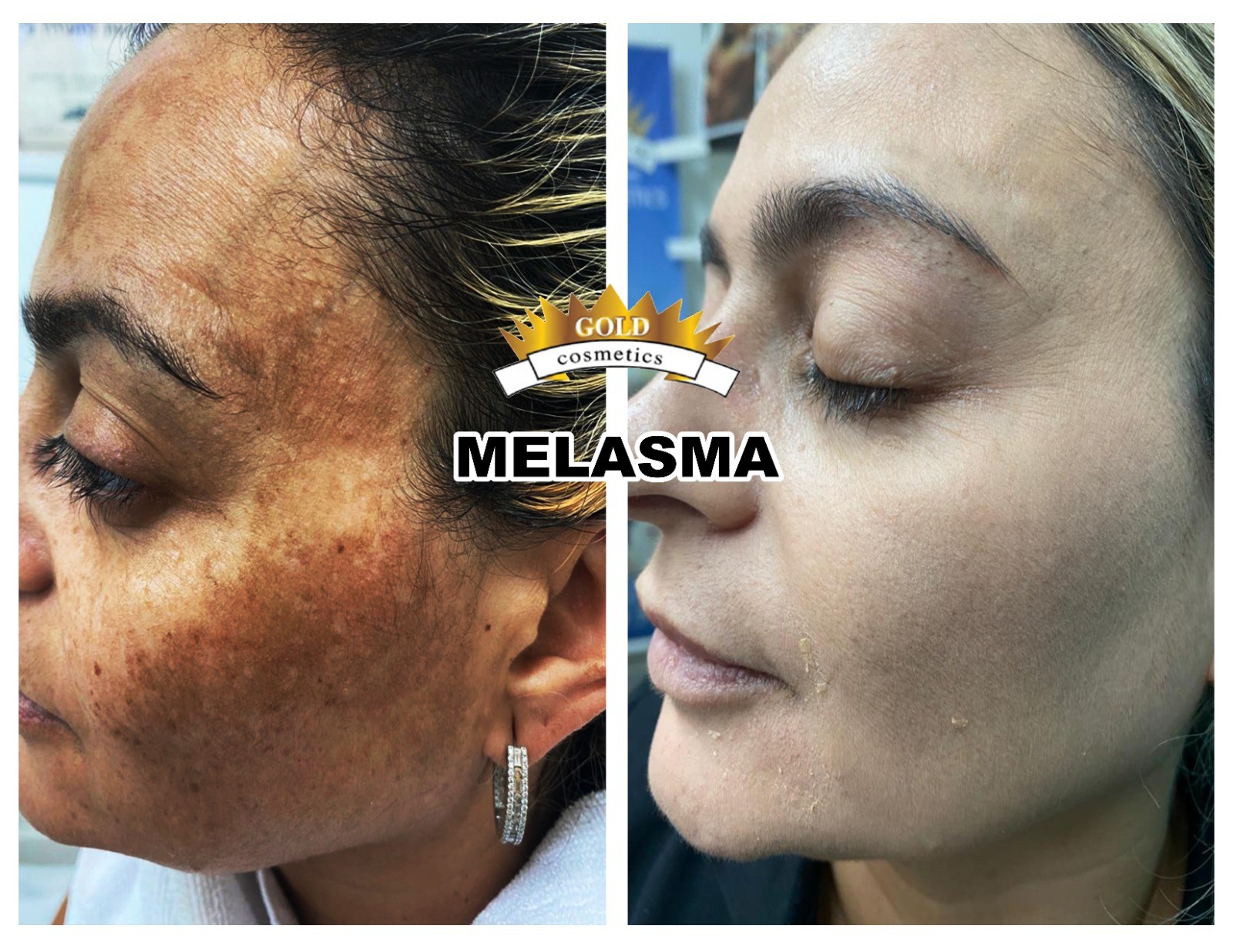
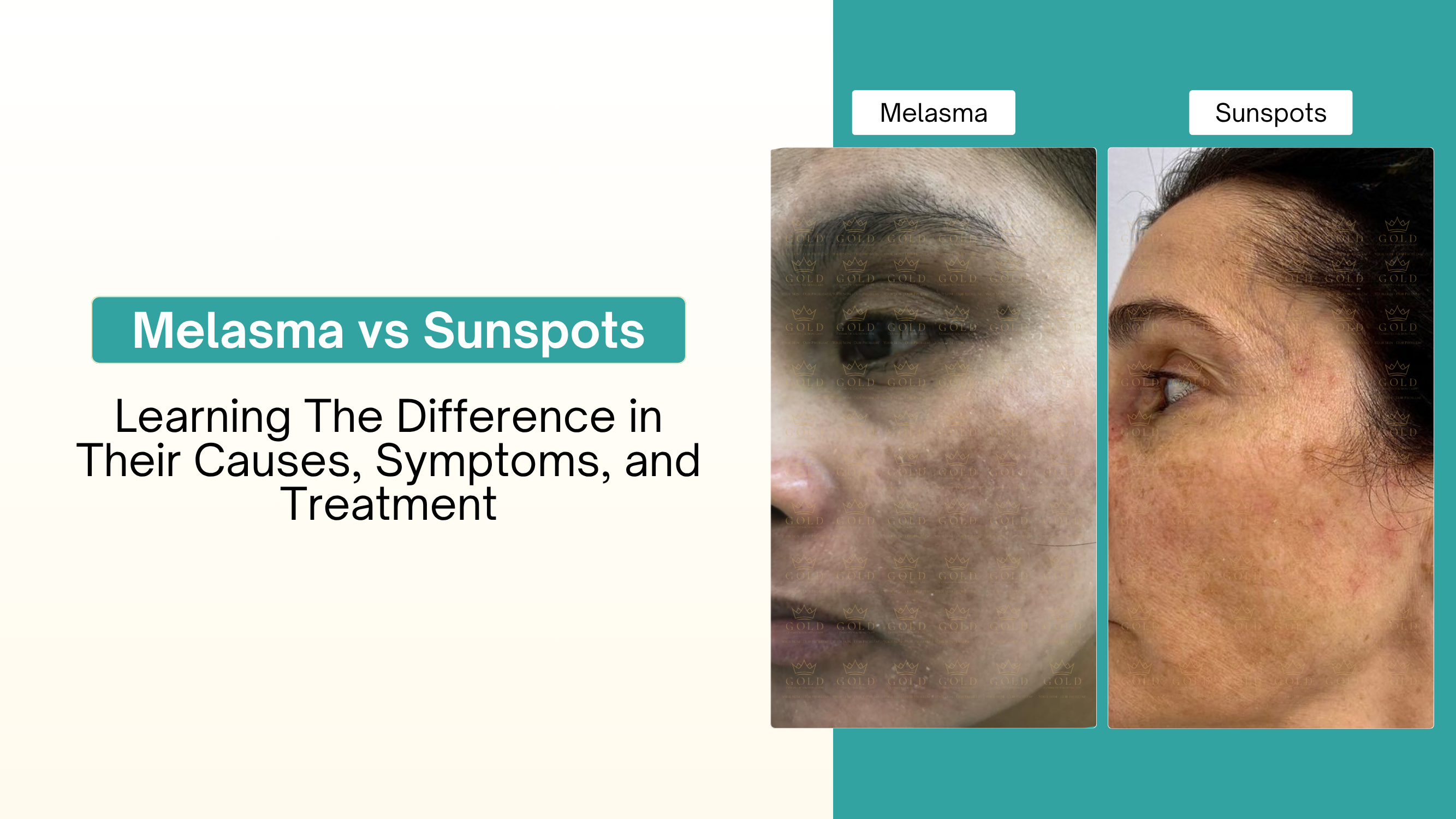
Melasma is a stubborn skin condition that usually appears as brown or gray-brown patches around the cheeks, forehead, chin, nose, or upper lip. Typically, it appears in irregular, distinctive patterns with poorly defined borders, similar to having stains on the skin. These patches normally occur symmetrically on both sides of the face, with different sizes ranging from small areas to larger stains. Unlike other forms of hyperpigmentation, melasma has a map-like appearance that seems to gradually blend into the surrounding skin instead of having well-defined edges. It can become lighter or darker over time, but it all depends on its major trigger. For instance, melasma triggered by sun exposure appears to become more noticeable during summer and less conspicuous during winter. This is why understanding its underlying triggers is very important.
For melasma to appear, it might require complex interactions of different contributory factors rather than a single trigger. This is why melasma tends to recur even after a series of treatments because the underlying causes haven’t been addressed fully. However, one primary culprit to suspect whenever melasma occurs is hormonal fluctuations. This factor is peculiar to women experiencing pregnancy, birth control use, or hormonal treatments. At this stage, they may undergo increases in estrogen and progesterone. These hormonal fluctuations trigger melanin overproduction by making the melanocytes more sensitive to heat and sunlight. At the slightest exposure, the melanocytes will start overproducing melanin. Another factor that plays a huge role is sun exposure. While sun rays alone may not directly trigger melasma in most persons, they can still activate or worsen the situation. Genetics and inflammation remain major contributors to melasma formation. Individuals with a family history of melasma have more tendency to develop it at some point in their lives.
Now, you may ask, who is at risk the most between men and women? Normally, we see melasma more in women who are still at their reproductive age (ages 20 to 50). But that doesn’t mean men can’t be affected as well. As a matter of fact, melasma is still rampant among people living in sunny climates or high-altitude areas, regardless of gender.
What are Sunspots and How Do They Look Like?
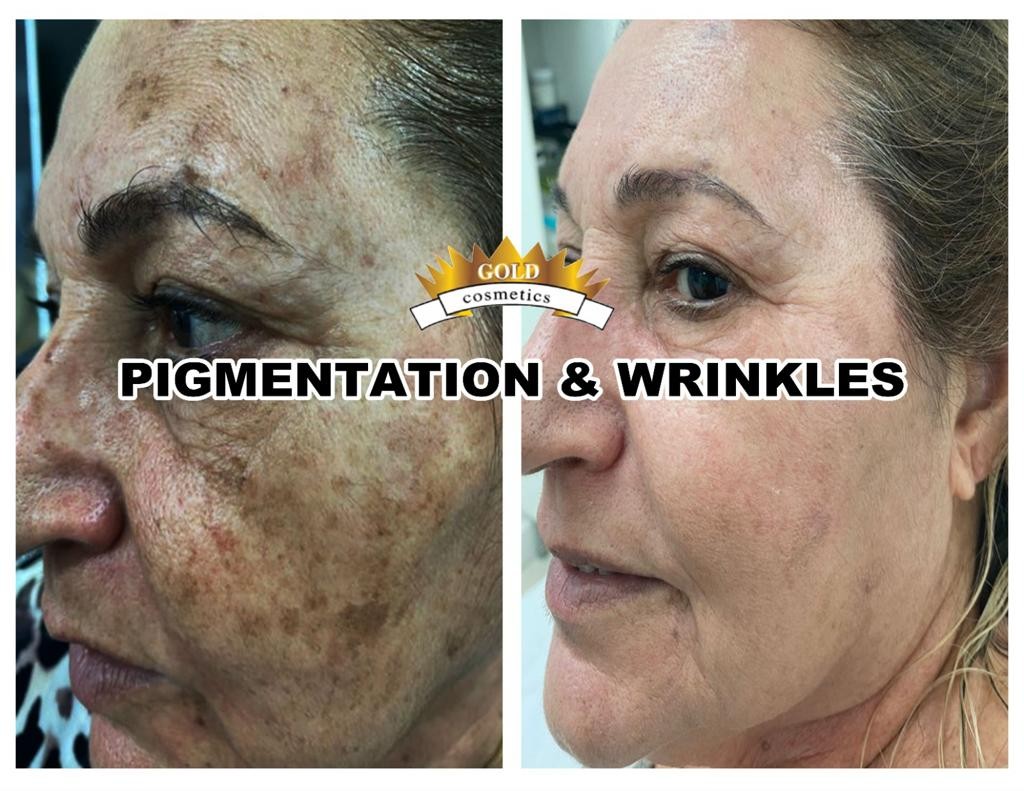
Also known as solar lentigines, liver spots, or age spots, sun spots are regarded as flat and well-defined brown spots that occur as a result of accumulated sun damage over time. Usually, they appear on most sun-exposed parts of the body, such as the face, shoulders, upper chest, back, hands, or forearms, etc. Unlike melasma, sun spots can easily be diagnosed and treated because of their straightforward behavior. When compared to melasma in terms of appearance, they are usually round in shape with sharp and well-defined borders. Unlike freckles or sunburns, which occur after sun exposure and disappear over time, sun spots hardly disappear on their own. Rather, they may expand and become darker with continued exposure to sun rays. Typically, you may notice them mostly in individuals who are above 40 with light skin tones. But that doesn’t mean you won’t develop them if you overly expose your skin to the sun, regardless of age.
As we earlier stated, sun spots develop as a result of accumulated UV exposure over the years. Each time you expose your skin to UV rays, it stimulates the pigment-producing cells known as melanocytes to produce more melanin as protection. Other factors to consider are age and skin type. As you advance in age, this sun damage accumulates more. Hence, you are most likely to notice them more after age 40. While these dark spots can affect all skin types, they tend to be more visible in individuals with light skin tone who have experienced significant sun exposure in most part of their lives.
Get this! Once sunspots are formed on your skin, they tend to become stable and will not fade on their own or change unless you undergo a professional treatment. Ironically, this attribute is what makes them predictable and largely responsive to treatments as compared to the changing nature of melasma. However, regardless of how long yours have lasted, rest assured we can help get them cleared off your skin.
How Do I Know If I Have Melasma or Sunspot?
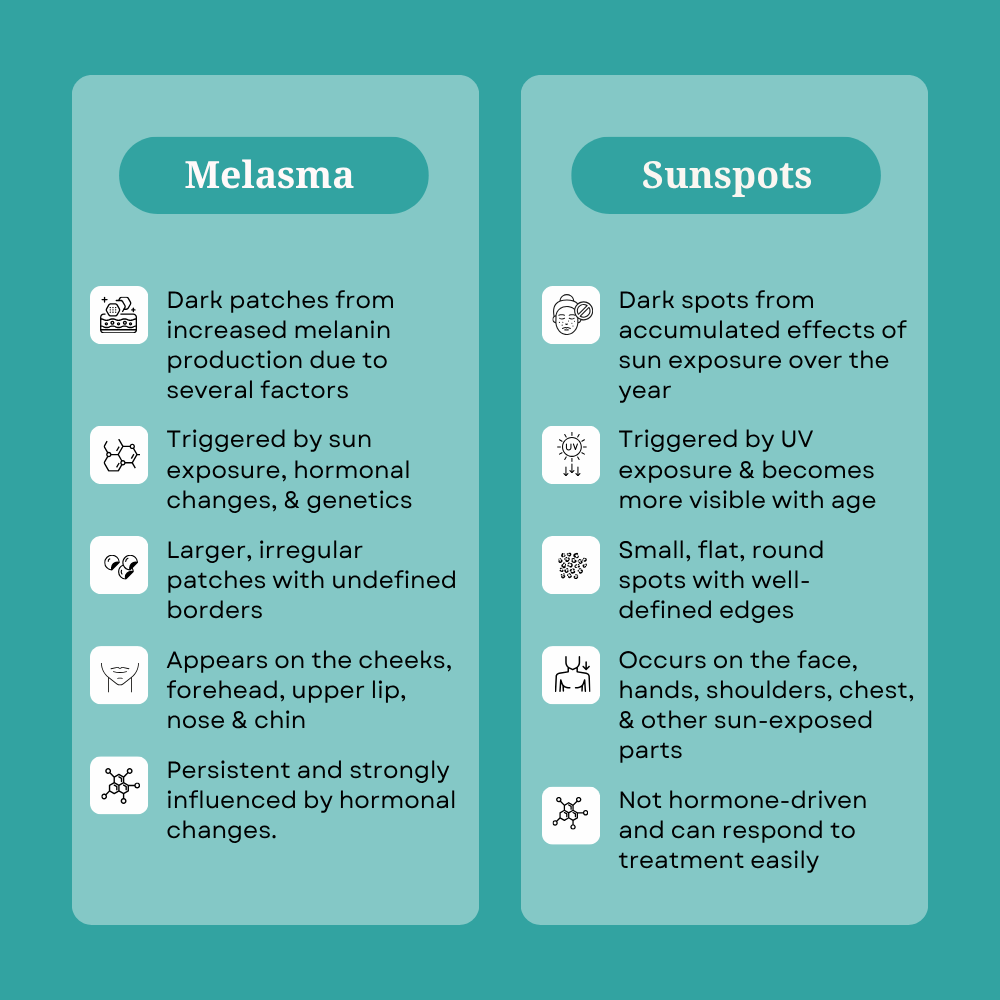
Having established what these two conditions are all about, let’s talk about their key differences. For this section, we’ll be placing them into 4 different categories: triggers, appearance, location on the body, and treatment.
Triggers
-
Melasma Triggers
Melasma is largely caused by complex interactions of different factors, including hormonal fluctuations during pregnancy, birth control, hormonal treatment, and certain medications. Other contributing factors are genetics, chronic inflammation, and vascular changes.
-
Sunspot Triggers
Unlike melasma, sunspots are directly caused by accumulated effects of UV exposure. Also, as you advance in age, their appearance becomes more noticeable, coupled with the slowing skin turnover cycle.
Location & Appearance
-
Melasma Appearance & Location
Melasma appears as irregular patches with undefined edges similar to stains on the skin. These patches are normally symmetrical on both sides of the face, appearing light to gray-brown. You are most likely to notice them around the cheeks, forehead, upper lip, chin, and nose bridge.
-
Sunspot Appearance & Location
On the other hand, sun spots appear as smaller, round dark spots with well-defined borders. Their color may range from light brown to dark brown. They mostly occur on sun-exposed parts of the body, such as the face, hands, forearms, chest, back, and shoulders. The distribution pattern follows the extent of sun exposure instead of facial symmetry, as compared to melasma.
Treatment
-
Melasma Treatment
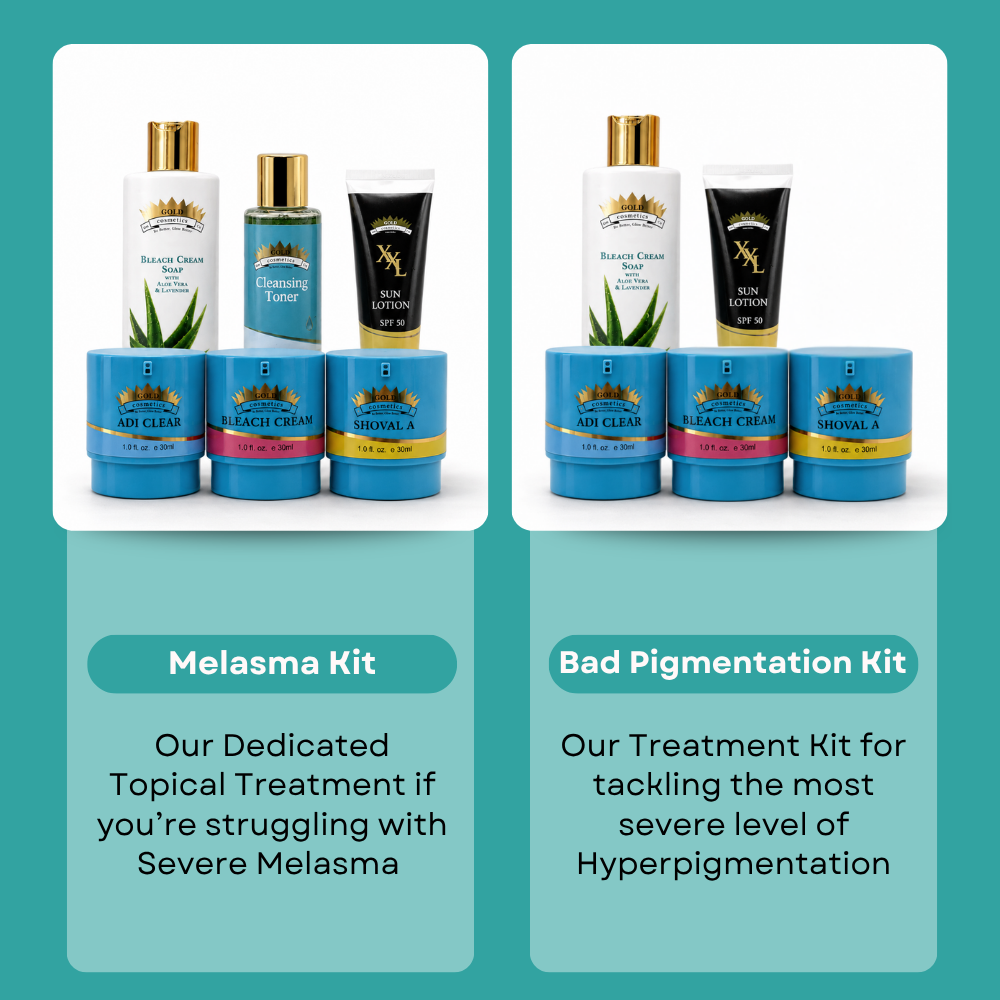
Treatment for melasma requires a detailed and long-term approach due to its complex nature. For some cases, topical treatments like Melasma Kit may be just enough to fade its appearance. In more severe cases, you may require more intense treatments like chemical peels or other professional procedures. This is why we recommend getting in touch with our experts to determine the best form of treatment.
-
Sunspot Treatment
Since sunspots are more predictable and respond easier to treatment, their tendency to recur after successful treatment is quite low. At Gold Cosmetics, we offer topical treatments like Adi Clear & Bleach Cream. These topical treatments can be effective in addressing your existing spots and preventing the formation of new spots. If you’re struggling with other hyperpigmentation marks, we also offer different pigmentation kits based on your severity level – Light Pigmentation Kit, Medium Pigmentation Kit, & Bad Pigmentation Kit.
Conclusion
While melasma and sun spots are two distinct skin conditions, it’s worth noting that they can still appear at the same time. But the key to effectively treating them lies in properly differentiating them from each other. As we’ve earlier established, melasma can be challenging to treat due to its complicated nature and changing triggers, while sunspots are much more predictable. They are largely triggered by cumulative effects from sun exposure. Though these two conditions have their unique triggers, UV exposure remains a common factor. And this is why we strongly advise never to skip your Sunblock SPF 50, especially in hot summer months when the tendency to develop melasma or sunspots is high.
Finally, we recommend booking our FREE consultation if you’re still not sure if you have either of them. Simply click the button below to connect with our experts for a more thorough skin examination. We’re expecting you!
Not sure which kit is right for you? Click below to send us a photo of your skin issue for a free consultation
REAL PATIENTS, REAL RESULTS!